For more than 40 years, Eaton has played a role in some of the most iconic performance vehicles on the road. From the original SVT Lightning and C6 Corvette ZR1 to Ford’s supercar-hunting S650 Mustang GTD, Eaton technology has helped deliver the power, traction, and control that define these machines.
That same OEM-level engineering is available to enthusiasts through the aftermarket. Eaton’s Twin Vortices Series (TVS) supercharger technology powers some of the biggest names in forced induction, while its driveline technology helps put that power to the ground. The Roush Phase 2 supercharger kit at the heart of our Aeromotive x Turn 14 Distribution Mustang GT giveaway vehicle relies on Eaton TVS technology, while an Eaton Detroit TrueTrac helps keep all that power in check on the track.
So, when Eaton’s Aftermarket Mobility Group invited the Turn 14 Distribution team to Marshall, Michigan, for a behind-the-scenes tour of its Proving Grounds, we jumped at the opportunity. We wanted to see firsthand how the same technology found in some of the world’s most capable performance vehicles is tested, validated, and pushed to its limits.
There are plenty of ways to learn about a performance product. You can study the specifications, analyze dyno numbers, and read through test results. But there’s something different about seeing that engineering in action and watching the numbers come to life on the track.


POWER PLAYGROUND
Eaton’s 600-acre Proving Grounds brings product testing and validation together in the heart of rural Michigan. A short journey from Motor City, prototype designs destined for aftermarket and OEM applications arrive here to have their capabilities stretched to the absolute limits in the name of improving what eventually reaches customers.
Superchargers, limited-slip and locking differentials, and traction-control systems are first evaluated on specialized test benches and dynamometers. Those components then move into vehicles for testing on a 1.6-mile oval, wet and dry skid pads, a dirt rally course, or a collection of inclines and obstacles designed to expose them to different loads and traction conditions. Complete with a fully equipped garage and even a cozy lodge, the Marshall facility is a self-contained campus built around pushing every product to the limit.
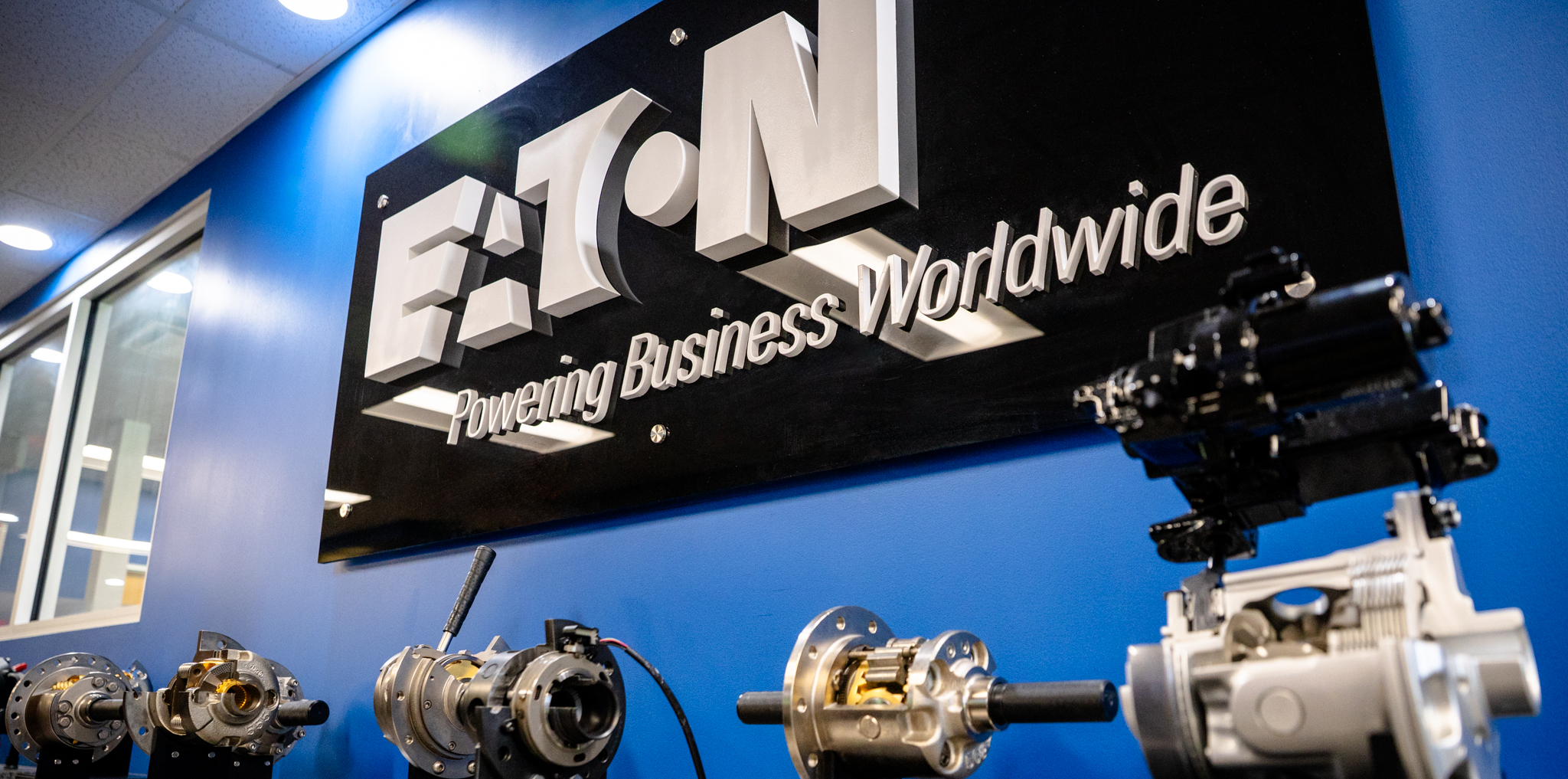
The engineering mindset is evident when stepping inside the main building. Cutaway product displays occupy nearly every available flat surface while rows of patent plaques climb the walls. There is plenty of pride on display, but it never feels like a showroom. The message is less look at what we can do and more here is how we proved it works.


SUPERCHARGED STRESS TEST
Before adding the characteristic whine to your thundering V8, Eaton’s superchargers have to be validated in the lab. Past the rows of patent plaques, Prototype Lab Manager Tim Kish guided us through a set of unassuming beige doors to the TVS supercharger torture chamber. Here, Eaton engineers secure prototype units to specialized test benches, where they can be subjected to conditions that would be difficult—or nearly impossible—to replicate through normal vehicle testing.
A supercharger can operate continuously at maximum load for more than 450 hours, equivalent to nearly 19 straight days of sustained abuse. Engineers can also cycle the load through various sweeps to ensure each unit is tested thoroughly across its operational range, or even simulate hot laps around Virginia International Raceway without leaving the building.
The goal here is not a simple power figure; rather, the Eaton team is verifying that these designs can continue to deliver that power under sustained, demanding conditions before reaching an OEM application or aftermarket build. Each component endures its time in the lab to prove it can survive the worst-case scenario, where the rest of the facility determines how it performs once it’s installed.
MISCHIEF MANAGED
Of course, making power is only part of the equation.
Another major focus of Eaton’s Aftermarket Mobility Group is distributing and controlling that added power. As our tour rounds the corner, we are brought to the driveline test cells. Here, engineers use specialized equipment and dynamometers to subject Eaton’s differentials to the same meticulous testing.
Where superchargers generate more power, differentials manage it. That can mean delivering a clean launch at the drag strip, carrying power through the apex of a road course, or steadily crawling over challenging off-road obstacles.
Driveline test benches lock the output shafts in place while applying as much as 12,000 lb-ft of force to the differential. Engineers can repeatedly load the component, identify its limits, and evaluate its behavior before moving testing outdoors.
This combination of laboratory and vehicle testing allows Eaton to isolate a component under controlled conditions, then determine how it responds once variables such as traction, elevation, and vehicle dynamics enter the equation. It’s a process designed to minimize variables while answering the question that ultimately matters: How do these components perform in the real world? Luckily, we were in the right place to find out.


HIT THE TRACK
Where the labs and test cells provide a controlled environment to prove these superchargers and differentials can take the abuse, the rest of Eaton’s Proving Grounds drops each part into the deep end. From the oval loop to the maze of incline grades, the facility feels like a playground for stress testing.
This was also the perfect opportunity to showcase and shake down the Turn 14 Distribution x Aeromotive S650 Mustang GT before it was shipped off to its new owner. The Roush Performance Phase 2 Supercharger kit at the heart of the build uses Eaton’s TVS technology, while a Detroit Truetrac limited-slip differential manages more than 820 horsepower. It was the ideal ride for a real-world product demonstration.
With Eaton’s seasoned drivers behind the wheel, our sales team was treated to hot laps around the oval in the Mustang before getting mud in the tires of Eaton’s own off-road-ready Jeep Gladiator. The Mustang put its power on display, with the TVS-equipped Roush supercharger shoving our team members into their seats while the Detroit Truetrac managed the chaos as the tires broke traction. The Jeep carried that demonstration into the dirt with a full showcase of Eaton’s e-lockers and their ability to tame challenging terrain.
It was a final shakedown with a fitting backdrop. This Mustang wasn’t just passing through. It was returning to the place where its key performance components were tested and validated. Seeing it run there brought the story full circle, turning Eaton’s Proving Grounds into the perfect backdrop for the finished build.
PROVEN BEYOND THE NUMBERS
There are plenty of ways to learn about a product and the brand behind it. But after touring stress-testing labs, watching products pushed to their limits, and fishtailing across a skid pad, spec sheets and PowerPoints only tell part of the story.
Our visit to Eaton’s Proving Grounds in Marshall, Michigan, gave our team a deeper understanding of the products they recommend to Turn 14 Distribution dealers every day. They came away with more than an understanding of fitment and part numbers. They saw the engineering, testing, and attention to detail that go into every product, and how those products can change the driving experience once they’re installed.
That knowledge didn’t stay in Marshall. Our sales team brought it back with them, giving them a better understanding of not just what Eaton products do, but why they perform the way they do.
Now, when a dealer calls about the parts for their next performance build, our team can draw on more than part numbers and specifications. They’ve seen the testing, felt the difference, and can speak from experience. They can speak from the passenger seat.