There’s a car that millions of enthusiasts have driven but have never seen. You have likely been behind the wheel of this legendary machine without laying eyes on it, or even knowing it exists in the real world. The Powerhouse Amuse Carbon R R34 GT-R was made a legend by the Gran Turismo racing simulator games, but for the last two decades, that’s the only world it truly existed in.
Outside of the digital realm, it was treated like a myth—a ghost story on dead forum threads that vanished from the public eye after the tragic passing of the man who built it. Some believed it was lost forever; others assumed it was locked away, collecting dust in a private collection.
That was until Colton Amster, owner of shopJDM and Redline Restorations, tracked down the sleeping giant. For two decades, the Carbon R was tucked away, leaving its signature dry-carbon body degraded and its mechanical systems in desperate need of resuscitation.
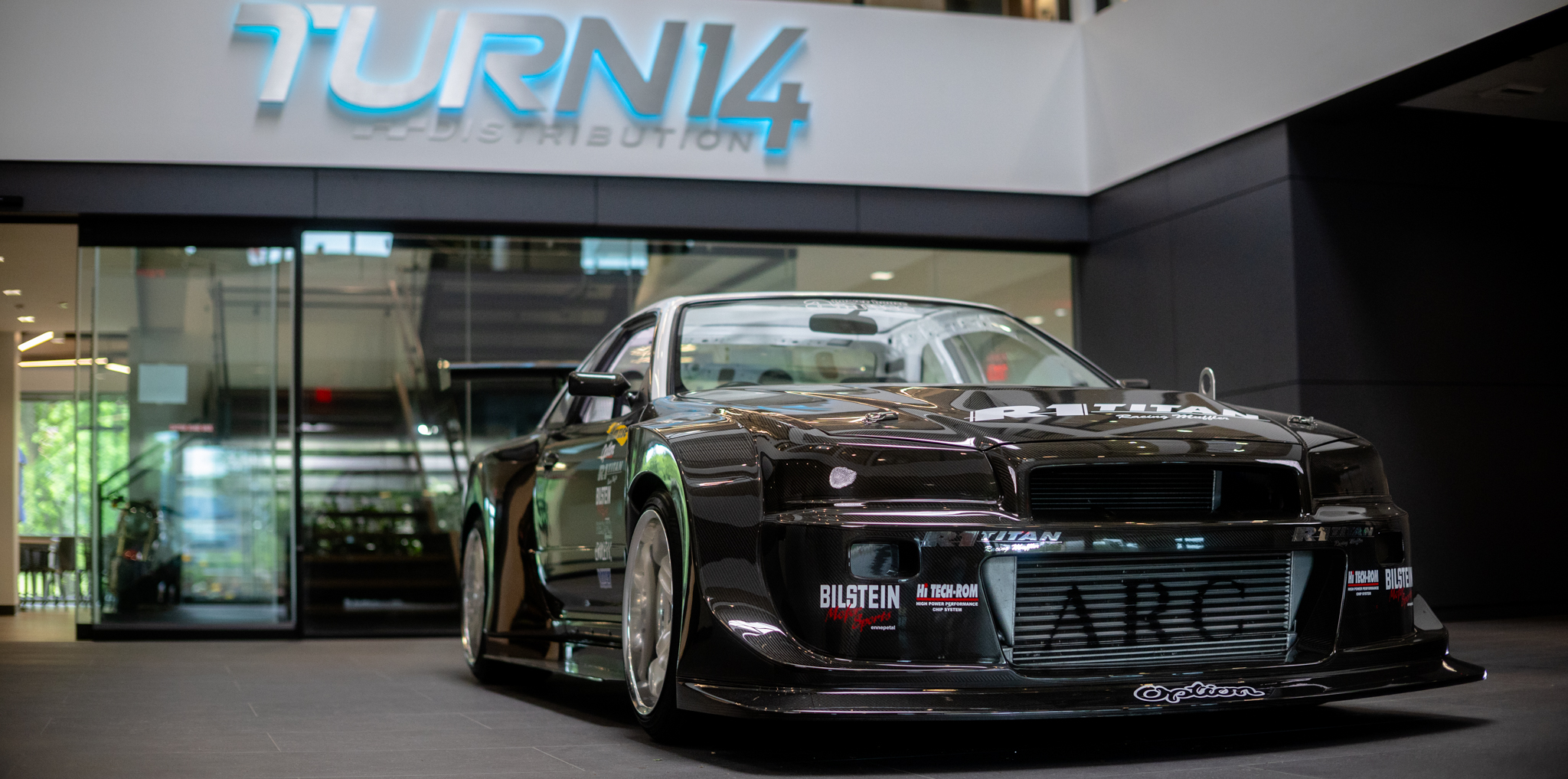
Rather than letting a legend deteriorate, Colton spent months meticulously refinishing the carbon skin, rewiring the electronics, and painstakingly resurrecting the icon until it breathed under its own power for the first time in twenty years. We were honored to display this piece of automotive history in the lobby of our headquarters.
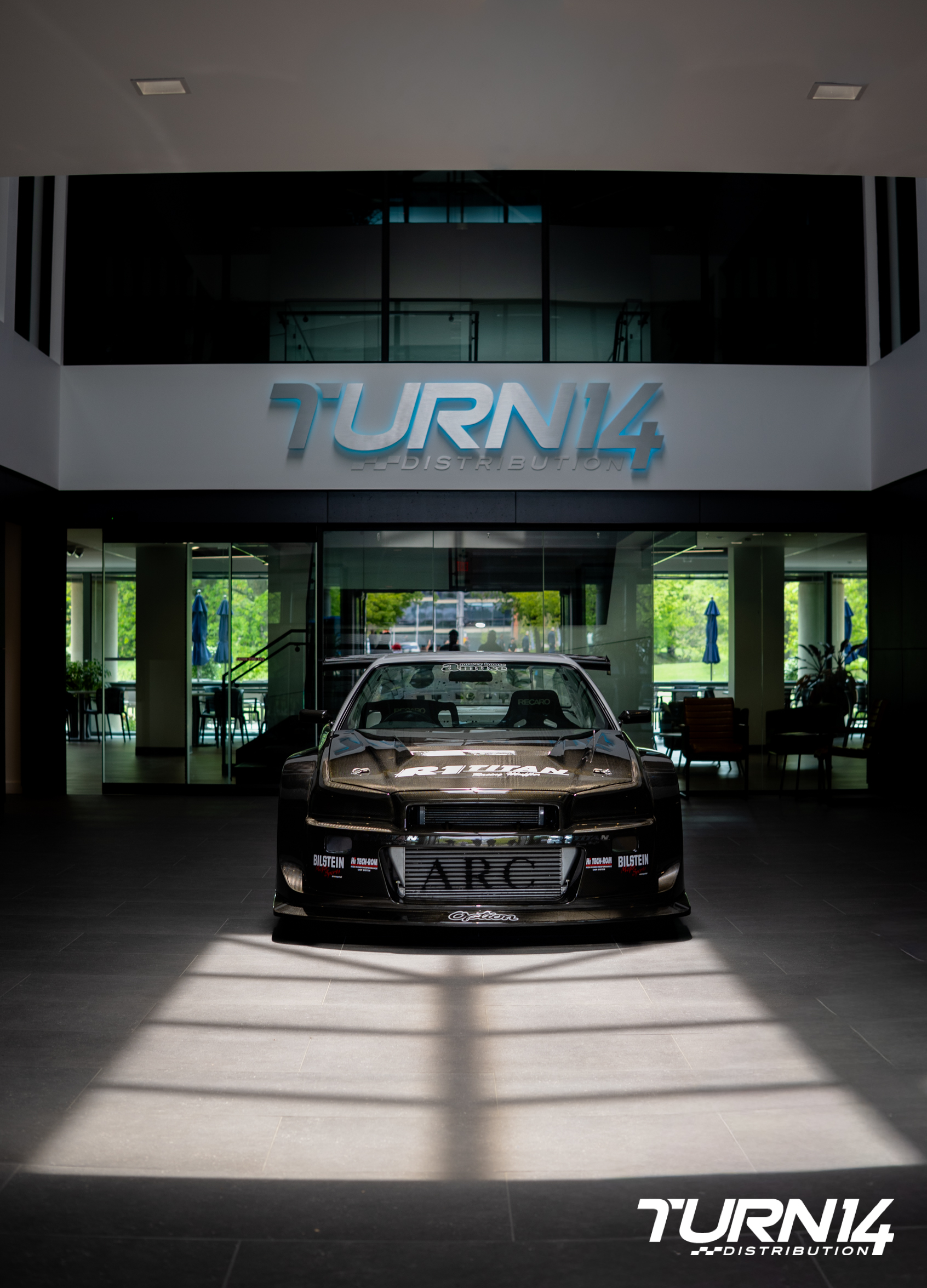
GODZILLA LIVES
To live the legend of the Carbon R, we first have to take a step back in time to Japan in the late 1990s. It’s the heyday of the JDM sports car. Fueled by a massive economic boom in the 1980s, the Japanese automotive industry transitioned from producing necessary, efficient transportation to pushing the absolute limits of performance. The same brands that once prioritized fuel economy were suddenly churning out absolute icons. By the new millennium, tracks and highways worldwide were dominated by legends like the Supra, the NSX, and, of course, the Nissan Skyline GT-R.
Now on its fifth generation, the R34 was the latest in the GT-R lineup to carry the infamous “Godzilla” moniker. Officially launched in January 1999, it came equipped with its trademark ATTESA E-TS AWD system paired with Nissan’s most capable powertrain yet: the RB26DETT. This 2.6L twin-turbo inline-six packed an official rating of 276 horsepower and 289 lb-ft of torque. However, those familiar with Japan’s “gentleman’s agreement” know that unofficially, that factory rating was a massive understatement.
Like its predecessors, this Skyline was built to bully the supercars of the era for only a fraction of their sticker prices. The stout power figures, combined with an advanced, grip-heavy chassis, made it the ultimate street weapon, with even more potential.


Photos provided by Redline Restorations
THE TUNER FROM CHIBA
Even when manufacturers produce a highly capable platform, there are always those who want more from it, and the R34 GT-R is a prime example. Thanks to its robust cast-iron block housing forged internals from the factory, the RB26DETT was over-engineered for its official output and provided tuners with a bulletproof foundation to chase mind-bending power figures.
Consequently, the R34 quickly became synonymous with absolute horsepower wars. But while the rest of the industry was caught up in building dyno queens and highway missiles, a select few knew that the Skyline was capable of much more than flexing its muscles at the drag strip.
Enter Hideki Tanabe.
Hailing from Chiba Prefecture, Hideki Tanabe ran one of Japan’s most respected tuning houses: Powerhouse Amuse. The shop built its name on lightweight titanium parts that were put to the test in circuit-proven demo cars. They operated under a core philosophy of sharpening the overall vehicle dynamics rather than simply chasing peak dyno numbers. Tanabe wasn’t just the head of the shop; he was all in, often getting his hands dirty as a hands-on builder, tuner, and driver. When the R34 first hit the Japanese streets, he saw its immense potential but felt that the rest of the industry was focusing on the wrong aspect.


DIET NISMO
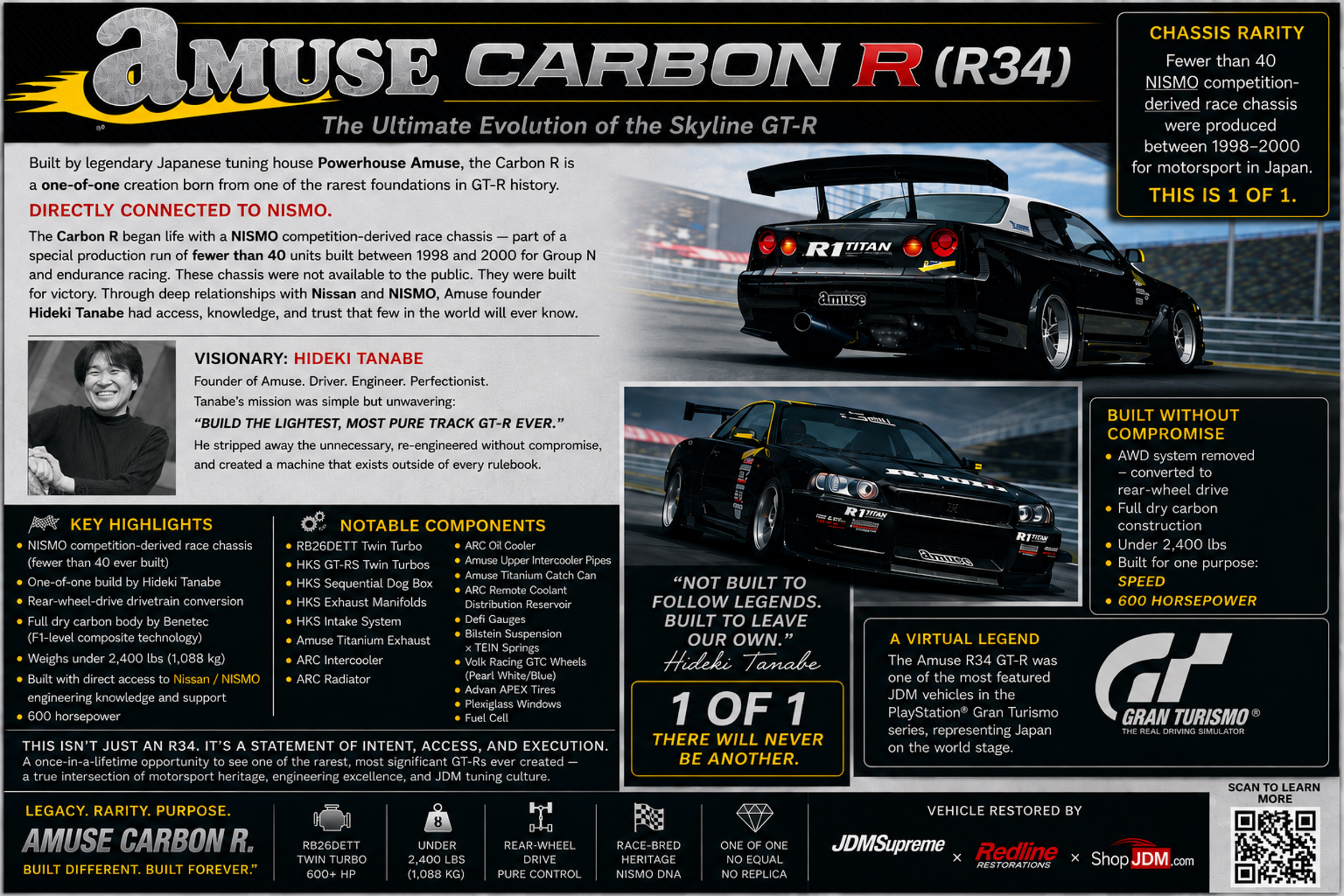
The Carbon R already started at a distinct advantage over other GT-Rs. It was constructed using one of only 40 rare, NISMO competition-derived race chassis built specifically for Group N and endurance racing, and delivered to Tanabe as a testament to his relationship with Nissan. This specialized unibody featured additional spot-welding on the steel structure and strategically placed carbon fiber-reinforced polymer (CFRP) to increase chassis rigidity for improved performance on the track.
With the already potent RB26DETT under the hood, the team set out to remove everything that was weighing it down. The NISMO chassis included specialized, lightweight body panels, but those didn’t last long under Tanabe’s watch. Every exterior panel was removed from the car and replaced with custom dry carbon fiber components to achieve the eventual weight loss goal. Doors, hood, front and rear fenders, bumpers, the rear wing, the diffuser, and even the headlight housings were all removed and replaced with carbon fiber in the name of weight savings. The only original exterior remnants were the roof and the structural pillars.
Tanabe didn’t stop at the bodywork, either. The heavy ATTESA E-TS AWD system—the very technology that gave the R34 its legendary status—was deemed unneeded mass. The entire all-wheel-drive system was pulled in favor of a much lighter, rear-wheel-drive drivetrain sourced from a 300ZX. All said and done, the Carbon R tipped the scales at just 2,400 pounds, shaving 1,000 pounds off the curb weight of a factory R34 Skyline GT-R.


SHARPENING THE WEAPON
While Tanabe and Powerhouse Amuse focused heavily on weight savings to sharpen their track weapon, they did not ignore the powertrain. They simply didn’t need four-digit power figures to make their point.
Instead of chasing an arbitrary dyno number, the team focused on perfecting the response of the RB26DETT. The engine received a calculated overhaul using the era’s finest components, optimizing internal efficiency, thermal management, and exhaust flow without over-stressing the engine’s reliability. Every upgrade was chosen to flatten the power band and sharpen throttle response, rather than pushing the engine to its absolute limits. Tanabe topped off the balanced setup with a proprietary, full-titanium Amuse exhaust system.
The combined efforts of these refinements netted approximately 520 horsepower. By today’s standards and even the standards of the time, 520 sounds like a modest number—until it is put into context. To start, it is nearly double the output of a stock Skyline GT-R. More importantly, that power is immensely effective when pushing a chassis that weighs only 2,400 pounds. This gave the Carbon R a power-to-weight ratio of roughly 4.6 pounds per horsepower, placing it directly in the same elite performance territory as the iconic Ferrari Enzo.


DON’T TALK ABOUT IT, BE ABOUT IT
The essence of the Carbon R was never meant to boil down to a static spec sheet; it was built to be a fully functional, dominant track vehicle. Tanabe frequently demonstrated its hypercar-level capability on the asphalt, most notably clocking a blistering 57-second lap time at Tsukuba Circuit in highly unfavorable track conditions. For perspective, even Nissan’s modern, top-spec R35 NISMO GT-R clocked in two seconds slower at the same proving ground decades later.
This immense track capability, achieved without over-stressing the engine, cemented the car’s lore. Tanabe’s build threads on automotive forums were constantly alive with users relishing every update on the car’s progress. From the forums, the Carbon R made its way to enthusiast magazines, eventually gaining digital immortality when it became a staple garage car in Gran Turismo 4.
AN ERA INTERRUPTED
Tragically, that momentum came to a sudden halt in September 2008 when Hideki Tanabe passed away from an undisclosed illness. The loss was devastating; the tuning community hadn’t just lost a shop owner, but a true titan who looked at automotive engineering through an entirely different lens.
Following his passing, the Carbon R faded from the public eye. The timing coincided with a broader shift in the automotive landscape. The economic bubble that propelled the golden era of JDM performance had long burst, leading to a quiet era of financial stagnation. As manufacturers felt the financial stress, the legends that had dominated the roads were being discontinued one by one, with the R34 capping the Skyline GT-R production in 2002. The Carbon R didn’t just vanish as a physical car—it disappeared at the exact moment the world that created it was transitioning away. For nearly twenty years, it remained a digital ghost.


Photos provided by Redline Restorations
PRESERVING AUTOMOTIVE HERITAGE
Colton and the team at Redline Restorations didn’t just restore a machine. They rescued a piece of culture that belonged to the people. They saved it for the kids who came home to run a few digital laps after school, for the forum lurkers who preserved its memory in compressed JPEGs, and for everyone who feared the physical car was lost to time. They preserved a monument to one of the automotive industry’s legends.
And that is precisely why its presence in our lobby was so significant.
At Turn 14 Distribution, vehicles like the Carbon R represent far more than carbon fiber or performance stats. They are tangible reminders of why this industry exists. The dedicated builders, the performance brands, and the dealer networks all connect back to a singular mission: keeping car culture alive, authentic, and moving forward.
For builders taking on legacy restorations of this magnitude, having a robust support system matters. Resurrecting an irreplaceable icon requires seamless access to the right brands, the right network, and the correct parts to ensure the history is preserved accurately. Featuring the Carbon R in our lobby isn’t just about displaying rare machinery—it’s about putting the historic stories that shaped our collective passion directly back in front of the community that cares about them.
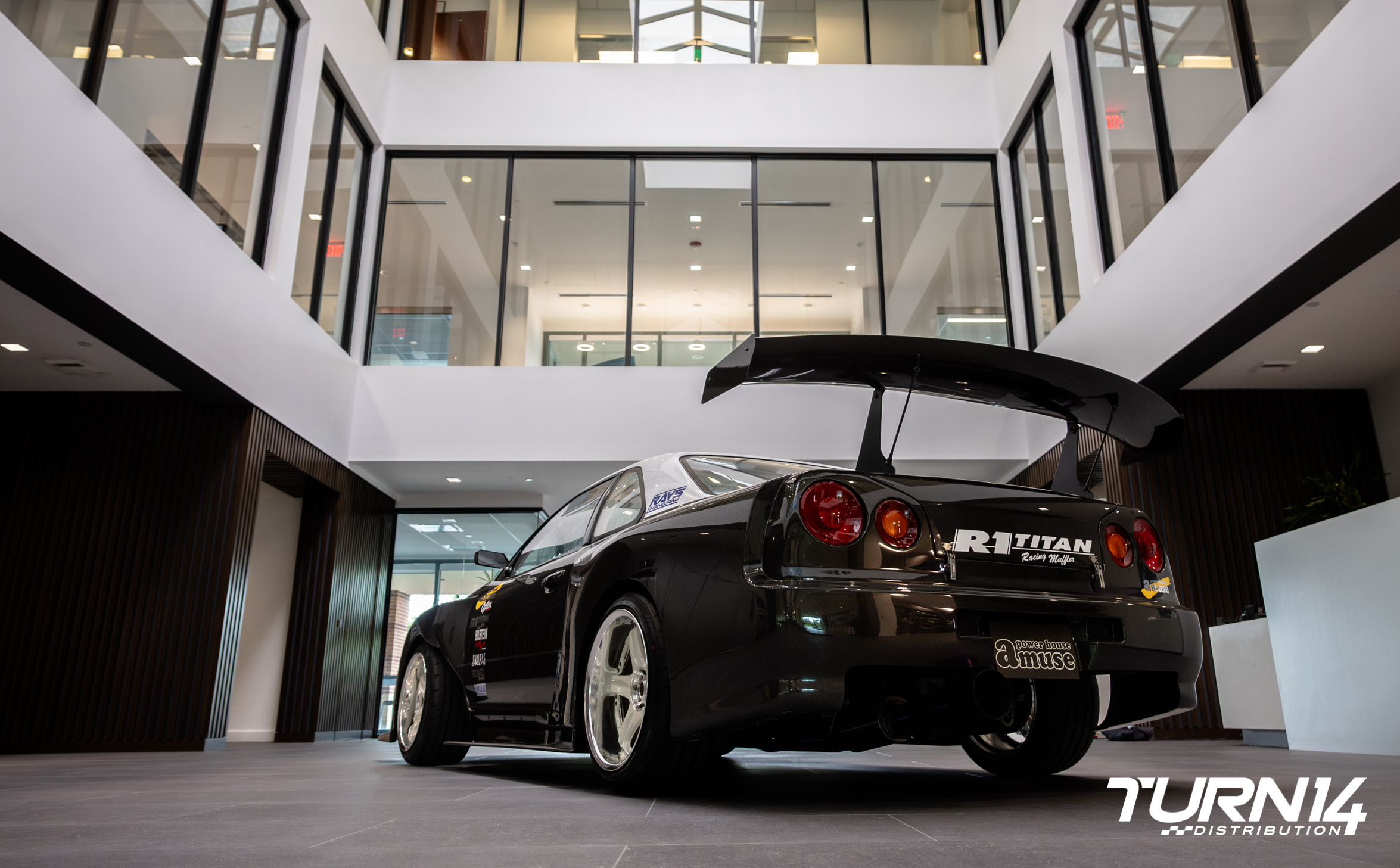
FROM CODE TO CARBON
The Carbon R in the Turn 14 Distribution lobby bridged a twenty-year gap, bringing the digital legend back into the physical world for everyone who put in the seat time in Gran Turismo. For a generation that grew up driving this car on a screen, standing next to the actual chassis was a powerful reminder of what brought us to this industry in the first place. It proved that the legendary builds we idolized as kids weren’t only hype—they were real machines, built by visionaries who weren’t afraid to push boundaries.
The Carbon R was built to prove that balance and weight savings would always beat brute force. By bringing this icon back to life the right way, Colton and the Redline Restorations team didn’t just restore a rare car—they preserved Tanabe’s memory and philosophy and kept a vital chapter of JDM history alive for today’s builders.
We extend a massive thank you to Colton Amster, shopJDM, and Redline Restorations for resurrecting this legend and letting us share its presence with our team, our dealers, and the community.